Direct Build-Up After Dental Trauma Using Ecosite Elements Composite Material. Max-Richard Seidemann
Max-Richard Seidemann
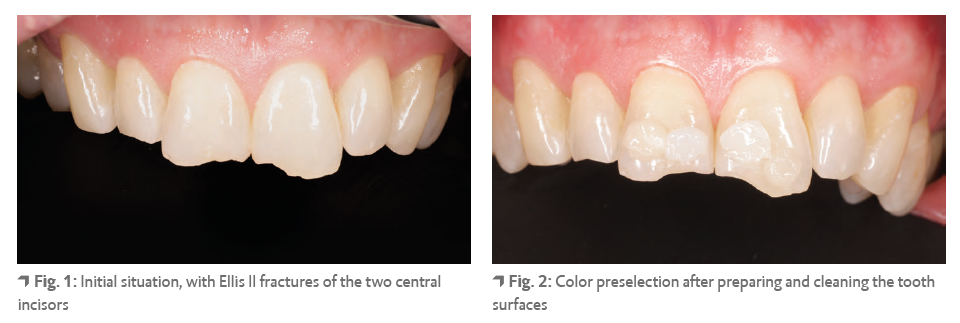
A 43-year old male patient spontaneously attended our practice with Ellis II fractures of the two central incisors after biting on a peach stone (Fig. 1). As the patient works as a consultant and had a job-related appointment the same day, he demanded swift and immediate esthetic rehabilitation.
Since the fragments were missing, a composite resin restoration appeared to be the first choice due to its minimally invasive nature. Considering the patient's esthetic dilemma and time pressure, it was agreed with the patient that a fast freehand direct build-up should be tried rather than an indirect technique.
Both teeth were vital and a radiographical review revealed no pathological findings. Apart from the Ellis II fracture tooth, 11 had a minor enamel fracture on the distal-vestibular edge and tooth 12 on the incisal edge. The patient wanted to leave these smaller defects untreated, since they were already in that state for several years.
The sharp edges were removed, and a buccal bevel prepared. After cleaning the tooth surfaces, a color preselection was conducted and Ecosite Elements A3 with an EM Layer was chosen (Fig. 2). The tooth surfaces were etched for 30 seconds (starting with the enamel surface only, then, after 15 seconds, also covering dentin areas with etching gel for a further 15 seconds) with phosphoric acid (DMG etching gel 37%) (Fig. 3). Subsequently, a matrix band was applied between the two central incisors before the bonding step was carried out using DMG Ecosite Bond (Fig. 4).
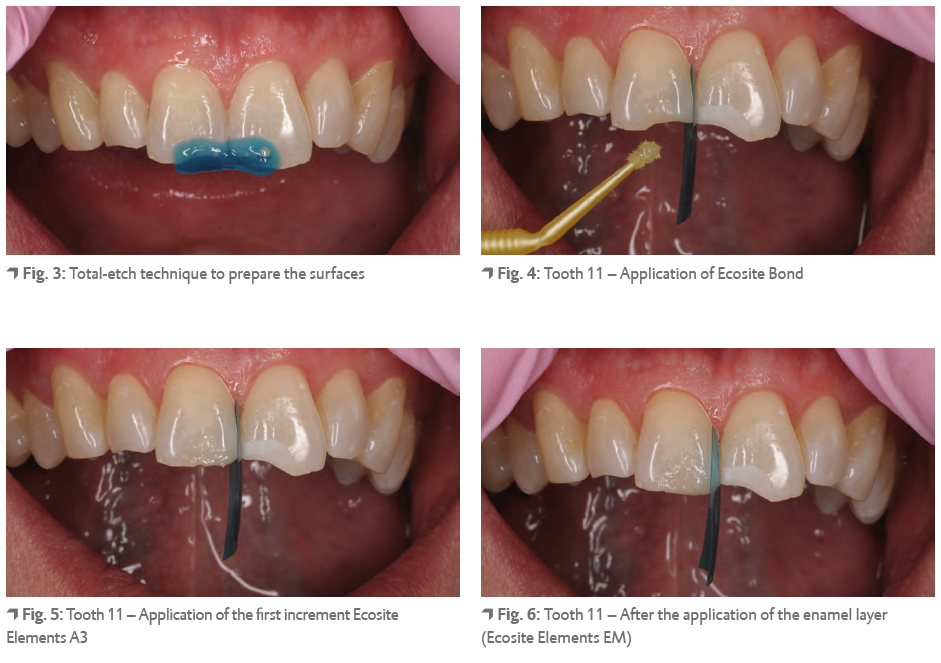
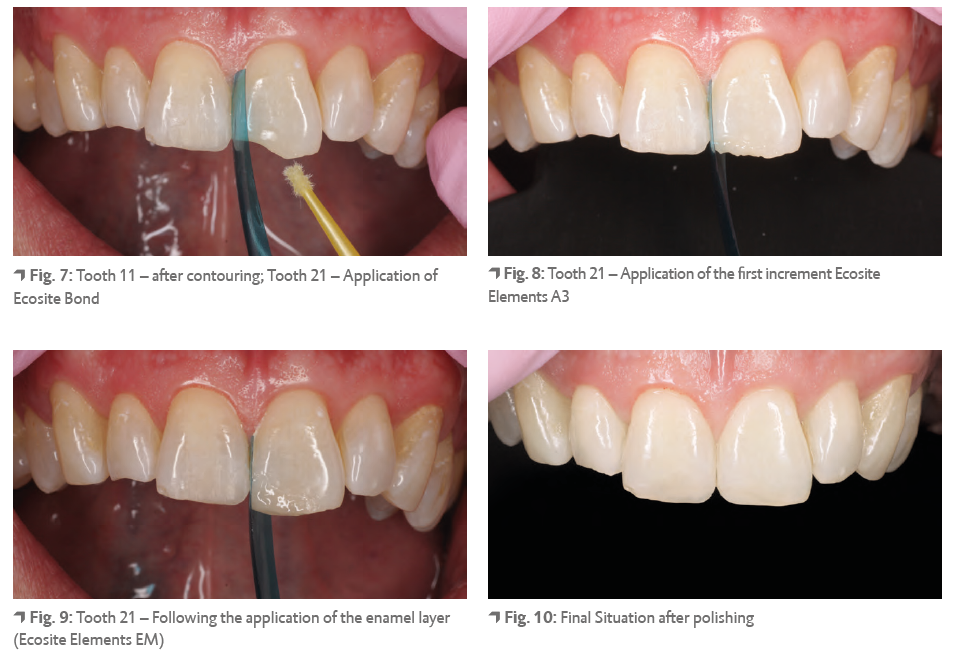
The first increment used was an A3 applied freehand and irregularly to achieve a natural look (Fig. 5). Next came the final EM Layer of the Ecosite Elements Layer set (Fig. 6). Each increment was light-cured for 20 seconds. A first rough contouring and finishing step with Soflex discs and a diamond bur were performed, before the separation and bonding procedure was performed on tooth 21 (Fig. 7).
As previously, tooth 21 was built up using a multilayer freehand technique (Figs. 8, 9). Subsequently the restorations were contoured, finished and finally polished with composite rubber polishers and a silicon carbide brush. Figure 10 shows the final situation.
In an everyday general practice setting in particular, the ability to provide swift, reliable and esthetically pleasing solutions for unannounced cases like this one is crucial. It became clear that its optimal consistency and non-stick nature would allow Ecosite Elements to restore and rebuild teeth swiftly and efficiently. Apart from ideal handling properties, the simple shade selection with optimal variety and great polishability were also key to an esthetically satisfying outcome.
Accordingly, the Ecosite Elements system offers a versatile and user- friendly restorative material, which allows the clinician to provide patients with a high-quality material to satisfy them and their esthetic requirements, however tight the schedule.
 Max-Richard Seidemann