Since its launch, Midas has done one thing exceptionally well: single-unit chairside restorations. Scan, design, print, deliver all before the patient leaves the chair. For practices that adopted it, Midas changed the economics and logistics of same-day crowns, inlays, onlays, and veneers.
But it also raised a natural question: what about everything else?
The patient who needs a three-unit bridge. The case that calls for two adjacent crowns. The full-arch temporary that’s currently a lab send-out because there’s no way to produce it chairside. These cases have sat at the edge of what Midas could handle and that edge has pushed a significant volume of restorative work back into traditional workflows.
Midas Multi-Unit Capsules are designed to erase that line.
What’s Actually Changing
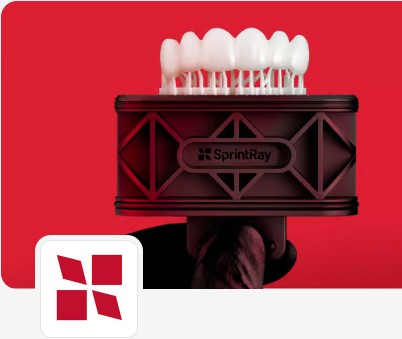
The new Multi-Unit Capsules feature more than three times the build area of existing single-unit capsules. That’s not a marginal upgrade it fundamentally changes what fits on the build platform and, by extension, what’s possible in a single production run.
With the expanded build area, clinicians can fabricate multiple crowns, inlays/onlays, veneers, and temporary restorations in one print cycle. The capsules are compatible with three key materials in SprintRay’s restorative portfolio:
SprintRay OnX Tough 2 SprintRay’s flagship permanent crown material, built for strength, aesthetics, and long-term clinical durability.
SprintRay Crown HT A high-translucency option for cases where esthetics are the priority, particularly in the anterior zone.
SprintRay Digital Temp For temporary restorations, including long-term provisionals and bridge temporaries that need to hold up through phased treatment plans.
The critical detail: these capsules work with existing Midas printers. There’s no new hardware to purchase. If you have a Midas on your counter today, multi-unit production is a capsule swap away once they ship in Spring 2026.
The Cases This Unlocks
To understand why this matters, think about the cases that currently fall outside your chairside workflow.
Same-day bridges. A patient presents with a failing three-unit bridge. Today, most practices scan or take an impression, send it to a lab, fit a temporary, and schedule a second appointment two to three weeks later. With multi-unit capsules, the bridge can be designed in Cloud Design and printed chairside in the same appointment. One visit. One fee collection. One satisfied patient.
Larger quadrant cases. Multi-tooth restorations across a quadrant three-unit bridges, extended spans, cases that previously meant either multiple separate runs or a lab case now complete in a single print. The workflow stays in-house and within one appointment.
Multi-unit temporaries. Phased treatment plans often require provisionals that hold up for weeks or months. Digital Temp in the multi-unit format means durable, well-fitting temporaries can be produced in-house instead of relying on a lab or hand-fabricating them chairside.
Complex treatment acceptance. This one’s less obvious but potentially the most impactful. Patients are more likely to accept comprehensive treatment when they know it can be completed in fewer visits. “We can take care of all three of these today” is a fundamentally different conversation than “we’ll need to schedule two more appointments after the lab sends everything back.”
Trial smiles. Prepless veneer mockups one of the most compelling case acceptance tools in esthetic dentistry are now a single-run workflow. Eight to ten units across the anterior arch print together in one Midas Multi-Unit run, giving patients a same-visit preview of their final result before any preparation happens. It’s a powerful conversion tool, and the production cost is minimal compared to the case value it supports.
What This Means for Practices Already Running Midas
If you’re already using Midas for single-unit production, multi-unit capsules shift your calculus in a few specific ways.
Higher revenue per appointment. You’re already achieving same-day delivery on individual restorations. Multi-unit capability means the average production value per Midas appointment can increase significantly you’re delivering more prosthetics per visit without proportionally increasing chair time.
Fewer lab send-outs. Every case you currently send to a lab because it exceeds single-unit scope is a candidate for in-house production. That’s not just a cost savings it’s a workflow simplification. No impression shipping, no case tracking, no second-visit scheduling.
Better case acceptance. The ability to say “yes, we can do that today” on multi-unit cases opens conversations that previously ended with “let me send this to the lab.” Same-day convenience is a powerful patient motivator, and extending it to complex cases removes one of the last common objections.
No disruption to your current workflow. You’re not learning a new system or integrating new hardware. Same Midas, same materials, same software just a larger build area that accommodates more units per run.
What This Means for Practices Considering Midas
If you’ve been evaluating Midas but hesitating because single-unit production didn’t justify the investment for your case mix, multi-unit capability shifts that calculation.
Practices with higher volumes of bridge work, multi-unit restorative cases, or phased treatment plans now have a significantly broader set of applications running through the same platform. The return on investment math looks different when same-day delivery extends to cases that previously required a lab.
“Chairside dentistry is moving beyond single restorations,” said Amir Mansouri, CEO of SprintRay. “When practices can confidently produce multiple restorations in one visit, they improve performance, affordability, and deliver a better patient experience all at once.”
Availability
Midas Multi-Unit Capsules are expected to ship in Spring 2026. If you’re already a Midas customer, your SprintRay representative can walk you through the transition. If you’re evaluating Midas for the first time, this is a good moment to look at the full picture of what the platform will support.
Contact SprintRay to learn more or read our full Chicago Midwinter recap to see everything else that was previewed at the show.
Frequently Asked Questions
What are Midas Multi-Unit Capsules?
They are upgraded capsules designed to expand the production capacity of Midas printers. With a larger build area, they allow multiple restorations to be printed in a single cycle.
Can Midas now produce same-day dental bridges?
Yes, multi-unit capsules make it possible to design and print bridges chairside in one visit. This reduces the need for lab work and follow-up appointments.
Do you need new hardware to use Multi-Unit Capsules?
No, they are compatible with existing Midas printers. Practices can upgrade capabilities without investing in new equipment.
What types of restorations can be printed with Multi-Unit Capsules?
They support multiple crowns, bridges, veneers, inlays, onlays, and temporary restorations. This significantly expands what can be produced chairside.
How do Multi-Unit Capsules improve workflow efficiency?
They allow multiple restorations to be printed at once, reducing production time and simplifying scheduling. This helps keep more treatments within a single appointment.
What materials are compatible with these capsules?
They work with key SprintRay materials including OnX Tough 2, Crown HT, and Digital Temp. These cover both permanent and temporary restoration needs.
How does this impact lab dependency for dental practices?
Practices can bring more cases in-house instead of sending them to labs. This reduces turnaround time and simplifies case management.
Will this improve patient experience?
Yes, fewer visits and faster treatment completion make care more convenient. Patients are more likely to accept treatment when it can be done the same day.
Is this useful for practices already using Midas?
Absolutely, it expands the value of the existing system. Practices can handle more complex cases without changing their current workflow.
When will Midas Multi-Unit Capsules be available?
They are expected to ship in Spring 2026. Practices can plan ahead to integrate them into their chairside workflows.