Initial™ LiSi Block is a fully crystallized lithium disilicate block that delivers optimal physical properties without firing.1-6 GC Initial LiSi Block features proprietary high density micro-nization (HDM) technology, allowing you to Mill, Polish, and Place your restorations in a single appointment, with no need for firing. Aside from beautiful opalescence, the structure of Initial LiSi Block ensures high strength and surface polish while enabling the fully crystallized block to be milled without deep microcracking or damage to margin detail.1 Enjoy a streamlined, time-efficient process without compromising on quality.
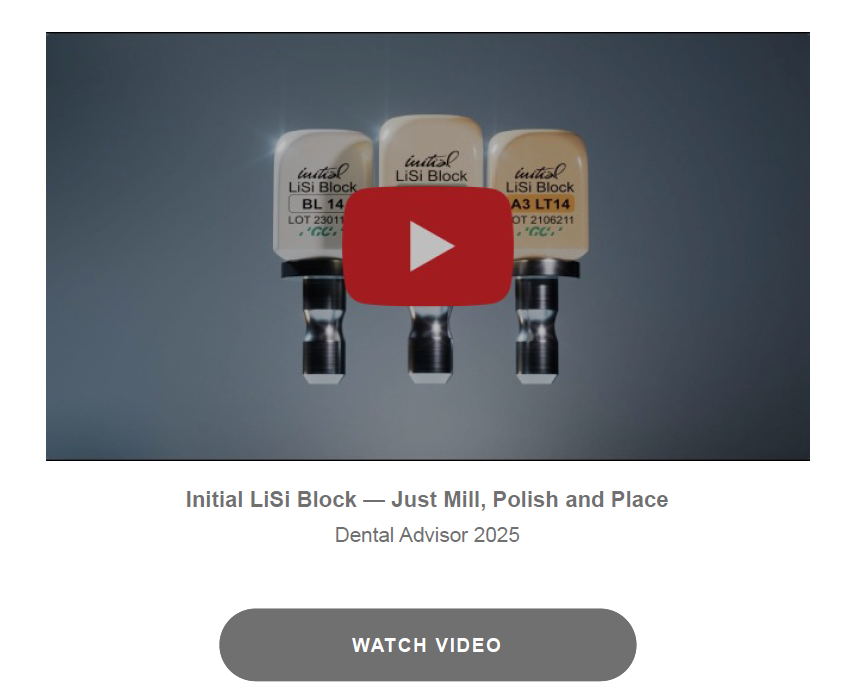
View the latest video from Dental Advisor illustrating the technology behind this fully crystallized lithium disilicate block.
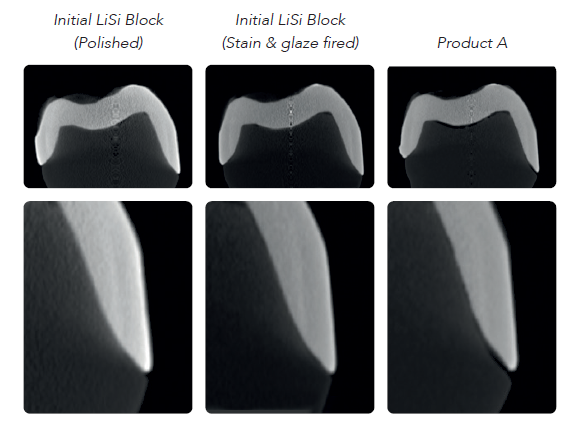
More accurate margins7
Being fully crystallized before milling, Initial LiSi Block can be milled with smooth and accurate margins directly. Alternatively, it can be fired after staining and maintain great marginal accuracy.
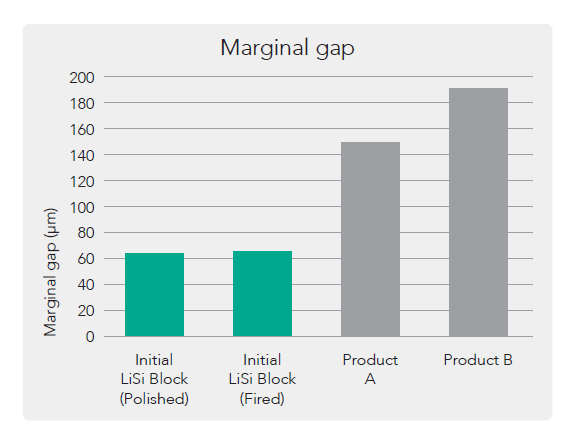
Source: GC R&D, Japan, Data on file [marginal gap was quantified by μ-CT system] available from info.australasia@gc.dental.
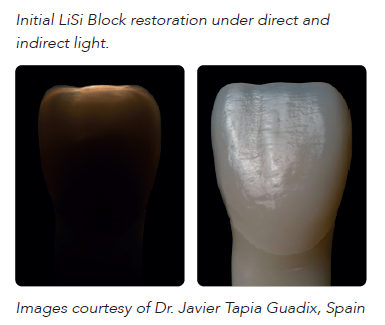
Natural opalescence
Initial LiSi Block is available in high translucency (HT) and low translucency (LT) and offers a natural opalescence in any light.
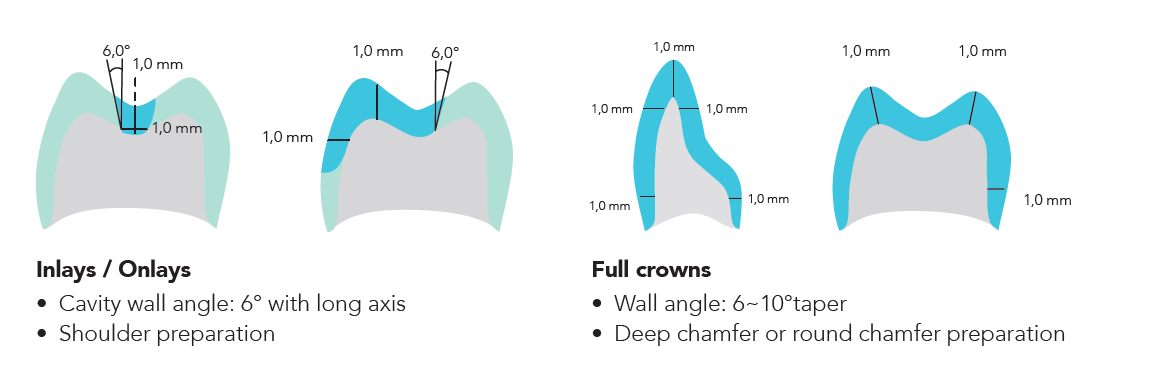
Preparation guidelines
HDM technology for CAD/CAM dentistry
In 2016, with Initial LiSi Press, GC introduced HDM (High Density Micro-nization) technology, which uses equally dispersed lithium disilicate micro-crystals to fill the entire glass matrix rather than using traditional larger size crystals. The outstanding clinical performance of the HDM technology was shown in a randomized clinical trial after 4 years of service.8
To bring fast solutions for one appointment dentistry, GC has further developed HDM technology for CAD/CAM dentistry by optimizing the crystal size and glass matrix stiffness. Thanks to this new technology, good machinability, marginal integrity, polishability, and wear resistance are achieved at the same time. The result is a strong and easy-to-mill block that offers the same strength with or without firing.7
Improved glass matrix stiffness for high mechanical strength
Smaller crystal for easy milling and high wear resistance
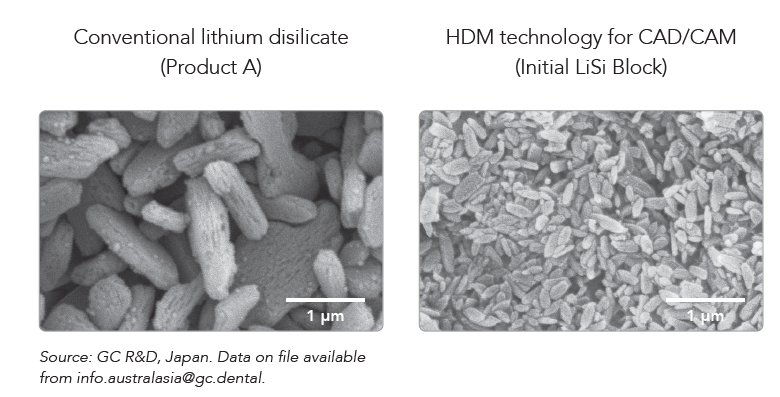
Source: GC R&D, Japan. Data on file available from info.australasia@gc.dental.
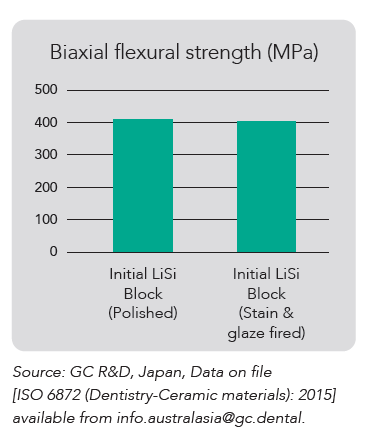
Source: GC R&D, Japan, Data on file [ISO 6872 (Dentistry-Ceramic materials): 2015] available from info.australasia@gc.dental.
Reference:
1. Hoshino T, Matsudate Y, Sasaki K (2020). Wear resistance of CAD/CAM glass ceramic blocks. J Dent Res 99 (Spec Iss A):1823, (https://iadr.abstractarchives.com/abstract/20iags-3294486/wear-resistance-of-cadcam-glass-ceramic-blocks).
2. Kato K et al. (2020). Edge Chipping Resistance of Glass Ceramic Block for CAD/CAM. J Dent Res 99 (Spec Iss A):0083, (https://iadr.abstractarchives.com/abstract/20iags-3315704/edge-chipping-resistance-of-glass-ceramic-block-for-cadcam).
3. Kariya S, Azuma T, Fusejima F (2020). Wear Resistance of Novel Machinable Glass Ceramics. J Dent Res 99 (Spec Iss B):1 (https://iadr.abstractarchives.com/abstract/jadr2020-3000018/wear-resistance-of-novel-machinable-glass-ceramics)
4. Hoshino T, Matsudate Y, Sasaki K (2019). Chemical durability of CAD/CAM glass-ceramic blocks. J Dent Res 98 (Spec Iss A):0100, (https://iadr.abstractarchives.com/abstract/19iags-3168964/chemical-durability-of-cadcam-glass-ceramic-blocks).
5. Kojima K et al. (2019). Wear properties of lithium silicate glass ceramic block for CAD/CAM. J Dent Res 98 (Spec Iss A): 1259, (https://iadr.abstractarchives.com/abstract/19iags-3178759/wear-properties-of-lithium-silicate-glass-ceramic-block-for-cadcam).
6. Akiyama S et al. (2019). Edge-Stability of the Novel Lithium Disilicate Glass-Ceramic Block for CAD/CAM. J Dent Res 98 (Spec Iss A): 0097, (https://iadr.abstractarchives.com/abstract/ced-iadr2019-3223282/edge-stability-of-the-novel-lithium-disilicate-glass-ceramic-block-for-cadcam).
7. GC R&D, Japan, Data on file [marginal gap was quantified by μ-X ray CT system] available from info.australasia@gc.dental.
8.Cagidiaco EF, Sorrentino R, Pontoriero D, Ferrari M (2020). A randomized controlled clinical trial on two types of lithium disilicate partial crowns. Am J Dent.
33(6):291-295. https://pubmed.ncbi.nlm.nih.gov/33439557/