
Over the last couple of decades, there has been a surge in research in studies involving dental lasers. Even more exciting is that laser dentistry is showing significant promise as the latest form of dental care — especially considering the opportunity dental professionals have to manage pain with photobiomodulation (PBM).
So, what is laser dentistry? Put simply, laser dentistry is an innovative method used to perform many dental procedures with precision and more gently to help minimize pain and recovery time for patients. This revolutionary piece of equipment has improved many soft-tissue and hard-tissue procedures that dental offices regularly perform. Even procedures that were previously often referred out can now be easily performed in-office with a dental laser.
Common Laser Dentistry Procedures
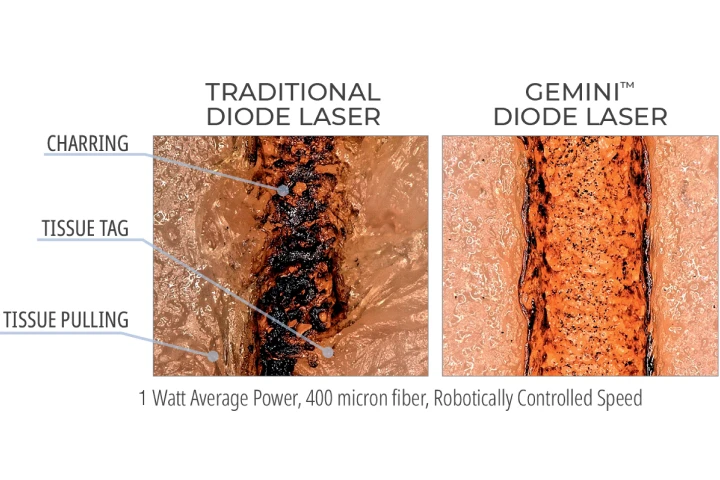
Currently, there are four types of lasers used in dental offices: Diode laser, CO2 laser, Erbium laser, and Nd:YAG laser. Typically, the type of laser a dental professional uses depends on the procedure as well as personal preference. For dental purposes, the laser cuts or vaporizes tissue, coagulates, cauterizes nerve endings, kills bacteria, and has a photobiomodulation effect.
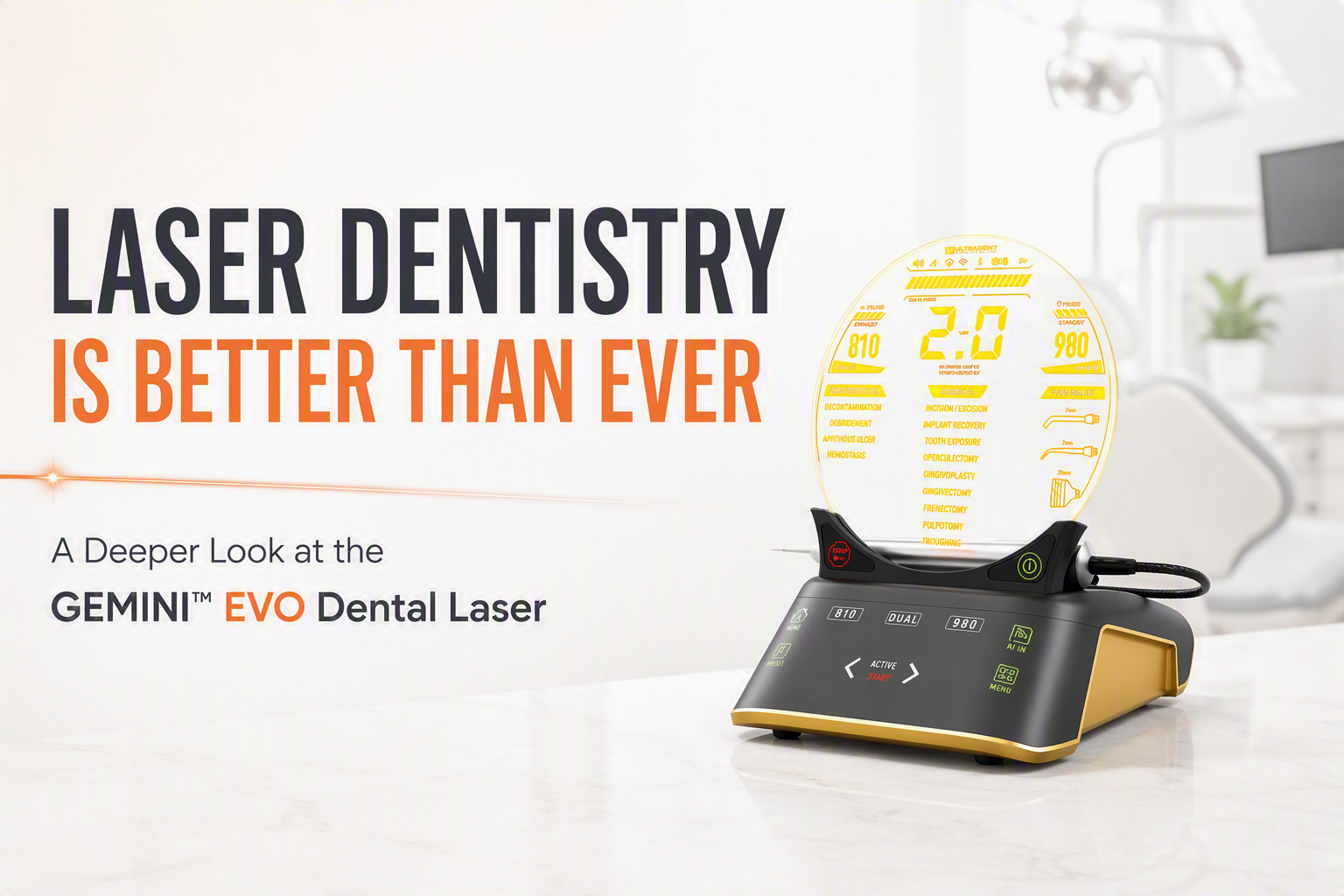
The Gemini EVO laser from Ultradent falls into the soft-tissue diode laser category.
Many soft-tissue procedures have become easier to perform with a dental laser resulting in gentler treatment of the patient. Not all dental lasers are purpose-made for soft-tissue procedures, so consider the type of laser your practice has before
starting any procedure.
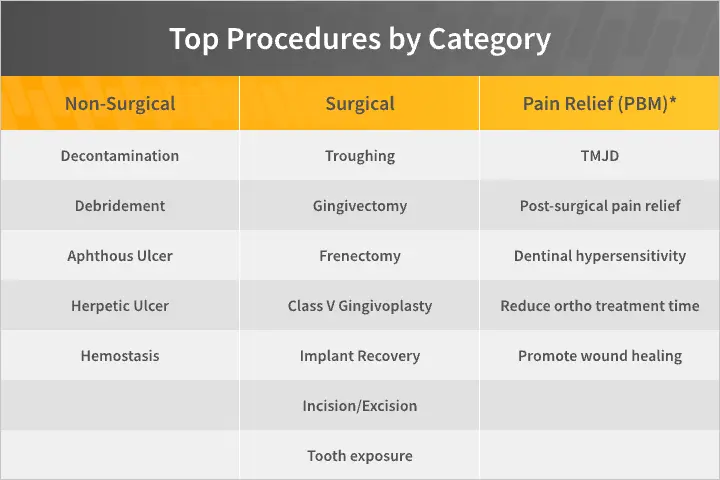
With the Gemini EVO laser some of the more common soft-tissue procedures include:
Surgical Procedures:
• Gingival troughing for crown impression
• Gingivectomy
• Gingival incision and excision
• Soft tissue crown lengthening
• Frenectomy
• Implant recovery
• Exposure of unerupted teeth
• Pulpotomy as an adjunct to root canal therapy
Pain Therapy with Photobiomodulation (PBM):
Topical heating for the purpose of elevating tissue temperature for a temporary relief of minor muscle and joint pain and stiffness, minor arthritis pain, or muscle spasm, minor sprains and strains, and minor muscular back pain, the temporary increase in local blood circulation; the temporary relaxation of muscle.
Pros and Cons of Laser Dentistry
Cost and return on investment (ROI), what types of dental procedures you’re interested in doing, and laser preference all weigh in when it comes to the pros and cons of purchasing a dental laser. Even though laser treatment options are expanding tremendously, dental professionals can find that they’re still limited in what they can do with a dental laser—especially with hard-tissue procedures.
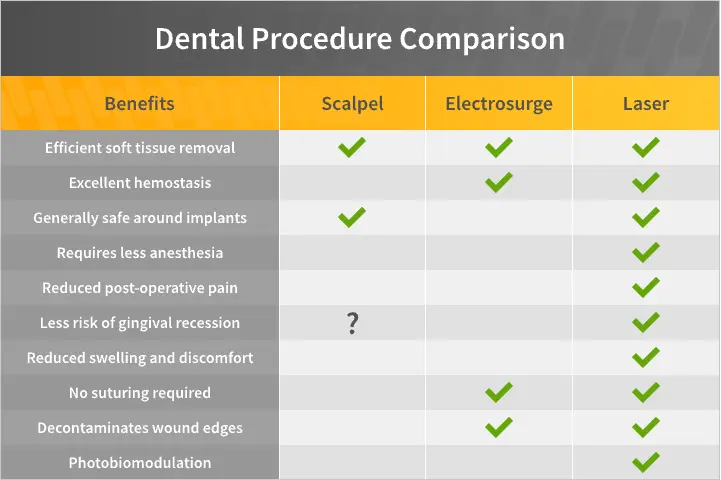
Historically, it has been a challenge for some dental offices to afford the upfront cost of a dental laser, and for some procedures, a laser can actually be a little slower than the traditional scalpel or electrosurge. For example, if you’re removing a fibroma, you could generally complete the procedure with a scalpel faster than you could with a laser.
The good news is that the upsides to purchasing dental lasers such as the Gemini and Gemini EVO far outweigh the downsides. Dental professionals around the world find major improvements when it comes to working with patients that have a fear of dental drills. With soft-tissue procedures, a laser coagulates and cauterizes as it cuts, producing less bleeding, discomfort, and respecting oral tissues. Patients still typically experience less post-operative pain and will heal faster than if a scalpel were used. Not to mention, most patients are fearful of a procedure that requires a scalpel.
The Gemini Laser Family
Laser dentistry has never been easier than with the Gemini laser family. The Gemini EVO lasers come ready to use with pre-programmed procedure settings. The dual-wavelength technology combines the optimal hemoglobin and melanin absorption of an 810 nanometer wavelength with the optimal water absorption of a 980 nanometer wavelength, making your procedures more efficient than ever before. With the Gemini EVO diode laser, guided Touch Interface with voice confirmation helps you make the proper selection with ease.
Both the Gemini and Gemini EVO lasers have convenient tip illumination to improve visibility at the surgical site and, to give you even greater control, variable intensity options allow you to adjust illumination as needed. No matter the procedure, the Gemini laser family makes your dental laser experience faster, smoother, and more efficient.
Photobiomodulation (PBM) is taking great strides in the dental industry, and now PBM treatment options are available with both the Gemini and Gemini EVO diode lasers. Both options include pre-set pain relief procedures for ease of use. The Gemini EVO also features an easy-to-use PBM treatment calculator to help you determine the proper treatment time. All you need to do is select the appropriate tip for the treatment area, select the treatment time, and let the laser do the rest.
Read the full blog post from Ultradent here