
Cancer. A word we’re all familiar with, a thought not so pleasing, and a community crisis that needs greater public awareness. So, how do we achieve this?
Oral cancer has become one of the six most common cancers globally. It affects the oral cavity soft tissues, hard tissues and oropharynx⁴. A variety of locations are affected by what is known as Oral Squamous Cell Carcinoma (OSCC). Much thought must be given to why many individuals are vulnerable to this disease. Many risk factors for oral cancer are linked to social habits and behaviours, such as smoking and alcohol consumption. These behaviours are very common and are the two leading and most harmful factors in the risk of developing oral cancer in the Australian population². However, further consideration of secondary determinants such as age, stress, nutrition, family history of cancer and viruses with particular focus on the Human Papilloma Virus (HPV), must be borne in mind. Although contributing factors have become well established, it is with risky behaviours and poorer health literacy⁴ that more and more cases of oral cancer are seen today.
OSCC exhibits unpredictable signs and symptoms, and to the untrained eye, is almost always undetected until later stages of manifestation⁴. Non-healing ulcers are found to be the most common sign of OSCC⁴. Roughly 49% of Australian patients have never heard of oral cancer and the many risks that contribute to the development of this illness³. Furthermore, not only is half the population unaware, only half of the Australian community currently attend for dental check-ups and oral cancer screenings each year⁴. This therefore limits early diagnoses and puts strain on oral care services. Many patients with oral cancer are unaware of their condition, predominantly due to the lack of early symptoms that may be easily identified, such as a runny nose when developing the common cold. Signs and symptoms are what usually drives a person to seek healthcare, however in the instance of OSCC, this generally occurs at a late stage of development. This results in over 60% of patients being diagnosed with stage III or IV OSCC with a five-year survival rate of 15-55%³. OSCC is a serious and life-threatening disease that requires further exploration, with focus on the how and why. How are new cases being found in some populations and not others, and why is this somewhat specific to a particular group? Social determinants.
Many healthcare professionals rely on specific determinants or ‘red flags’ to understand an individual’s risk of a disease or illness. In Australia, oral cancer diagnoses are more commonly seen in those with regular use of alcohol and who smoke, with the growing population over 40 having higher risk of OSCC³. Frequent use of tobacco products is linked to oral cancer, as either smoking or chewing of tobacco directly contacts many surfaces in the oral cavity. Long-term binge drinking is another behaviour which appears to be linked to cancer formation². Oral bacteria metabolise alcohol and produce acetaldehyde, a well-known carcinogen². Alcohol consumption, even when minimal or moderate puts an individual at risk of OSCC, 30 times greater when combined with long-term smoking⁶. It is with limiting or removal of these two specific determinants that your oral cancer risk is vastly reduced.
Social Determinants
Many risk factors or social determinants have been identified, but who will be at greater risk of oral cancer is the question. Not everyone who has a risk factor will experience oral cancer and not everyone who has little to no risk will be in the clear, so what makes the difference in early diagnosis? It is through regular oral health assessments and screening undertaken by a general medical practitioner or general dentist that early detection and risk status can be determined³. High-risk factors are seen as⁶:
● Long Term Smoking
● Heavy Alcohol Consumption
● Age of 40+
● History of Human Papilloma Virus (HPV)
● Family History of Cancer
● Poor Nutrition
● Stress
● Ultraviolet (UV) Exposure
● Patient Delay in Self-Detection of Signs & Symptoms
Additionally, many as yet unproven determinants/behaviours have been identified as potential risks for OSCC. Such as vaping, ill-fitting dentures and poor oral hygiene⁶. With a lack of evidence to suggest direct links, it may still be helpful to address factors with the potential for modification and positive health outcomes.
Early Detection
Improved public knowledge is shown to greatly decrease an individual’s risk, seeing as greater knowledge allows for greater understanding of consequences. Evidence suggests a trending decline in OSCC incidence in the Australian population as a result of lifestyle changes¹. This is supported via oral health promotion and campaigns such as graphic health warnings on cigarette packaging¹. Oral cancer has vast potential to be successfully treated when an early diagnosis is made, and it is by understanding one’s risk and maintaining oral cancer screenings that this can be better achieved³. In support of early identification, the following signs and symptoms in and around the mouth should never be overlooked⁴.
● Non-healing Ulcer
● Red/White Patches
● Continuous Bleeding Gums
● Difficulty moving Tongue
● Reduced Opening
● Pain on Swallowing
● Loss of Taste
● Altered Sensations
It is with modification of lifestyle factors and early detection via thorough oral cancer screenings, that greater prevention of OSCC is achievable⁵. Trained professionals should encourage safe alcohol consumption and endorse smoking cessation to those at high risk. By promoting healthier choices and regular dental checks, together this can positively improve an individual’s outcome and quality of life⁴.
References
1. Ramamurthy, D, Sharma, D & Thomson, P, 2022, ‘Oral cancer awareness in patients attending university dental clinics: A scoping review of Australian studies’, Australian Dental Journal, vol. 67, issue. 1, pp. 5-11, <https://onlinelibrary.wiley.com/doi/epdf/10.1111/adj.12877>.
2. Bosetti, C, Carioli, G, Santucci, C, Bertuccio, P, Gallus, S Garavello, W, Negri, E & La Vecchia, C, 2020, ‘Global trends in oral and pharyngeal cancer incidence and mortality’, Internal Journal of Cancer, vol. 147, issue. 4, pp. 1040-1049, <https://pubmed.ncbi.nlm.nih.gov/31953840/>.
3. Webster, JD, Batsone, M & Farah, CS, 2019, ‘Missed opportunities for oral cancer screening in Australia’, Journal of Oral Pathology & Medicine, vol. 48, issue. 7, pp.. 595-603, <https://pubmed.ncbi.nlm.nih.gov/31188491/>.
4. Yang, LC, Yang, A, Chen, LN, Firth, N, Prabhu, SR & Zachar, J, 2022, ‘Knowledge of Oral Cancer Amongst Dental Patients Attending Public Clinics in South East Queensland, Australia’, Journal of Cancer Education, vol 37, issue. 4, pp. 924-931, <https://pubmed.ncbi.nlm.nih.gov/33068265/>.
5. Wolfer, S, Kunzler, A, Foos, T, Ernst, C, Leha, A & Schultze-Mosgau, S, 2022, ‘Gender and risk-taking behaviours influence the clinical presentation of oral squamous cell carcinoma’, Clinical and Experimental Dental Research, vol. 8, issue. 1, pp. 141-151, <https://pubmed.ncbi.nlm.nih.gov/34989151/>.
6. American Cancer Society 2024, Can Oral Cavity and Oropharyngeal Cancers Be Prevented?, <https://www.cancer.org/cancer/types/oral-cavity-and-oropharyngeal-cancer/causes-risks-prevention/prevention.html>.
 Author Bio
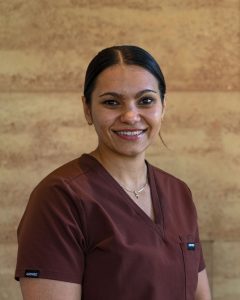
Latisha Sykora is a fourth-year student pursuing a Bachelor of Dental Surgery at the University of Adelaide. As a proud Mudburra-Jingili woman, she possesses great desire and commitment to elevate Indigenous oral health outcomes by promoting leadership and preventive measures. Latisha's journey in dentistry began in 2012, completing a school-based traineeship in dental assisting, an experience that fuelled her interest in oral disease, particularly in rural and remote communities. Her determination led to becoming a graduate Oral Health Therapist in 2019. Currently, she serves as a supporting clinician at the Indigenous Oral Health Unit (IOHU) at the University of Adelaide, while also devoting time to work in private practice. For Latisha, early intervention and education hold the key to achieving excellence in oral health. She actively demonstrates this belief by mentoring Indigenous students and serving as a Director of the Indigenous Dental Association Australia (IDAA). In 2022, she was awarded the Student Leadership Award for Indigenous Allied Health Australia (IAHA). Through her inspiring work and leadership, Latisha joins the Colgate Advocates for Oral Health: Content Community ready to embody a lasting impact on Indigenous oral health and create a brighter, healthier future for her community.