

INTRODUCTION
A bioactive and highly flowable mineral root canal sealer, BioRoot® Flow is based on Septodont’s patented Active Biosilicate Technology (ABS), which is composed of calcium carbonate, zirconium oxide, and tricalcium silicate, among other components.
Compared to mineral trioxide aggregate (MTA)—which also contains tricalcium silicate and has been available for over 20 years for retrograde apical fillings, repairing root perforations, pulp capping, and repairing internal root resorption—BioRoot Flow has a unique, pure formula with a premixed highly flowable composition, and ready-to-use syringe dispensing.
Designed for cold and warm techniques, BioRoot Flow made obturation easy during the following root canal procedure. In my opinion, BioRoot Flow is truly a next generation endodontic material.
CASE REPORT
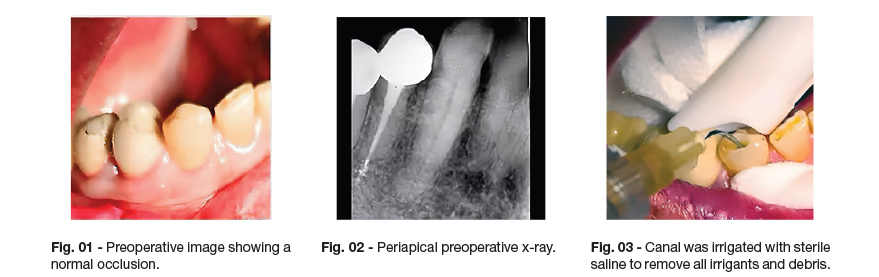
An 88-year-old man presented with spontaneous, lingering, and radiating mandibular sharp pain elicited by cold that radiated to the distal to tooth No. 31. Electric pulp testing evoked discomfort at setting 1. Occlusion was within normal limits (Figure 1). The patient was diagnosed with symptomatic irreversible pulpitis. A periapical preoperative x-ray was taken (Figure 2).
Preparing for Root Canal Therapy
The patient elected root canal therapy for tooth No. 27 and declined the use of a rubber dam and clamp. Two carpules of 2% Lidocaine with 1:100,000 epinephrine were injected as a mandibular block and a long buccal injection.
Access through the incisal edge composite was made. An electronic apex locator determined a working length with a No. 25 file at 27 mm. The canal was hand and rotary filed with NiTi files to 27 mm with sodium hypochlorite and liquid EDTA irrigants. The Crown-Down technique was utilized in filing. After filing was completed, the canal was copiously irrigated with sterile saline to remove all other irrigants and debris (Figure 3). Paper points were used to dry the canal.
Choosing a Bioactive, Next-Generation Sealer
A bioactive mineral root canal sealer, Septodont’s BioRoot Flow, was chosen for this procedure. According to Septodont, it is a uniquely resin free (no shrinkage), highly pure, calcium silicate formula that promotes the formation of hydroxyapatite where it contacts the tooth surfaces and also mineralizes dentin. Inside the dentin tubule lumens, BioRoot Flow crystallizes to provide tubule sealing, which is extremely important for long-term endodontic success.
BioRoot Flow has a high pH (alkaline) and can be used with different gutta-percha techniques, including cold and warm techniques.
The improved flow rate and formulation coupled with warm gutta-percha enhances BioRoot Flow’s ability to flow into accessory canals and provides better adhesion to dentin and gutta-percha. In the event of extrusion beyond the apex, BioRoot Flow is compatible but resists resorption.
Injection and Obturation
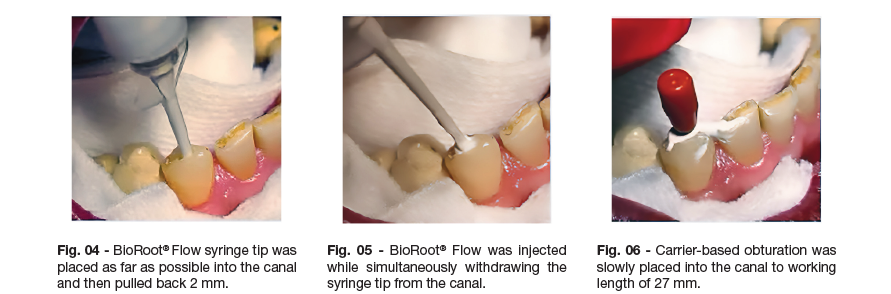
Using the intraoral syringe tip provided with the material, BioRoot Flow was injected into the canal and placed as far as possible into the canal and then pulled back 2 mm (Figure 4). Injection of the sealer was then initiated while simultaneously withdrawing the syringe tip from the canal (Figure 5).
A heated 27-mm long No. 25 carrier-based obturator was then slowly placed into the canal to working length of 27 mm (Figure 6). The handle and excess obturator were separated and removed with a Great White No. 2 highspeed bur.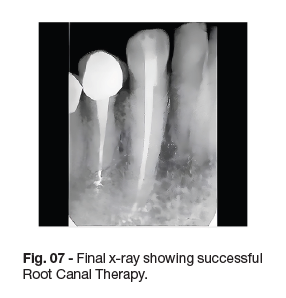
FINAL RESULTS
The access hole was restored with shade A2 of SDI’s Luna Flow flowable composite along with Kuraray’s CLEARFIL Universal Bond Quick. The composite was shaped with composite finishing burs and polished with Jazz polishers. A final x-ray was taken (Figure 7) and showed a successfully obturated root canal system. The patient reported no pain or cold sensitivity after treatment of tooth No. 27.