Factors to Consider when Choosing a Detergent for Dental Instrument Reprocessing
Selecting an appropriate detergent for cleaning reusable medical devices (RMDs) in a dental practice is more than just a matter of preference—it’s a critical step in ensuring patient safety, instrument longevity, and regulatory compliance. A well-informed decision should be based on a risk assessment, as guided by AS 5369:2023, which is the Australian Standard for the reprocessing of reusable medical devices. This involves evaluating the potential risks associated with inadequate cleaning and selecting products and processes that mitigate those risks.
Start with the Manufacturer’s Instructions for use (IFU)
The first and most essential step in selecting a detergent is to consult the RMD manufacturer’s IFU. Most medical and dental device manufacturers adhere to the European Medical Device Regulation (MDR), which sets stringent requirements for cleaning validation and product compatibility. These validated cleaning protocols often include specific detergent formulations tested during the development of the instrument.
 Key Detergent Components to Consider
When reviewing cleaning agents, the following components and characteristics are especially important:
Surfactants
Lower surface tension to allow water and detergent to reach all parts of the instrument, especially hard-to-reach crevices.
Builders
Help emulsify and suspend soils, preventing redeposition during the wash cycle.
Enzymes
Act as biocatalysts to break down organic matter such as blood (proteases), starch (amylases), and fat (lipases). Enzymes work efficiently at lower temperatures and are gentle on instruments.
Corrosion Inhibitors
Essential for protecting stainless steel and other metals from degradation, helping maintain appearance and function over time.
Alkalinity
Mildly alkaline detergents are often more effective in breaking down organic matter through saponification (conversion of fats into soap), while remaining material compatible.
Compatibility with Cleaning Methods
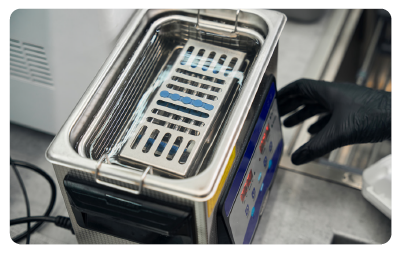
A versatile detergent should be usable in manual cleaning, ultrasonic baths, and washer-disinfectors (both under- and over-bench).
Validated Performance and Global Use
A growing number of dental RMD manufacturers include neodisher® MediClean forte in their validated cleaning protocols, referencing its compatibility and performance across a wide range of instruments.
MediClean forte is a mildly alkaline enzymatic detergent developed by Dr. Weigert, widely adopted across Europe in hospitals, dental clinics, and laboratories. Its unique formulation is designed to:
-
Remove denatured blood and organic residues
-
Prevent protein re-deposition
-
Provide material protection while maintaining cleaning efficacy
-
Be effective across all common cleaning modalities (manual, ultrasonic, automated)
-
Manufacturers that reference MediClean forte in their IFUs include: BA International™, Dentsply Sirona™, EMS Dental™, Forestadent™, Garrison Dental™, Horico™, Hu-Friedy Group™, KaVo™, Komet™, Morita™, Nobel Biocare™, Premier™, Straumann™, W&H™, MK-Dent™ and others.
-
Final Thought: Choosing a Trusted Product
-
While many detergents are available on the market, those supported by validated cleaning data, wide clinical adoption, and long-term material compatibility offer peace of mind for any practice. neodisher® MediClean forte, available through Henry Schein, is one such detergent—trusted globally and recognised by leading instrument manufacturers. For more information or assistance reviewing IFU requirements, please contact your Henry Schein representative.