Dr Luis Carrière, Spain
Aligners are highly efficient in achieving several dental movements, but they lose efficacy and predictability when used for distalisation of the posterior teeth. Normally, when we plan treatment using aligners only, we need to address the sagittal dimension of malocclusion by means of sequential distalisation. This sequential distalisation, or single-unit movement, aims to move the maxil- lary molars first, followed by the premolars and then the canines, one after the other.1
Sequential distalisation with aligners has several limitations:
- It restricts orthodontic treatment to either maxillary dental distalisation or mandibular dental distalisation in isolation whether treating a Class II or a Class III malocclusion.
- It extends the total treatment time, as aligner distalisation requires many steps to achieve maxillary or mandibular distal correction.
- Biomechanically, aligners frequently deviate from the planned movement during distalisation, leading to decreased treatment predictability.2
- It produces incisal protraction as a reaction to the distal movement in the posterior area of the maxilla.
The Carriere Motion Appliance offers a predictable hybrid treatment approach to distalisation when using aligners.2–4 This appliance is designed to focus on solving the sagittal dimension by moving groups of teeth, generating a Class I occlusion before any comprehensive orthodontic treatment. In this manner, the molars, premolars and canines are brought into a Class I relationship where the maxillary and mandibular first molars exhibit adequate distal rotation and adequate uprighting, depending on whether the clinician is treating a Class II or Class III malocclusion.5–7 This Class I occlusion is usually accomplished during the first four months of treatment with the Carriere Motion Appliance. This approach of achieving a Class I occlusion with the Carriere Motion Appliance prior to any further orthodontic treatment is described as the Sagittal First approach in the Carriere system.
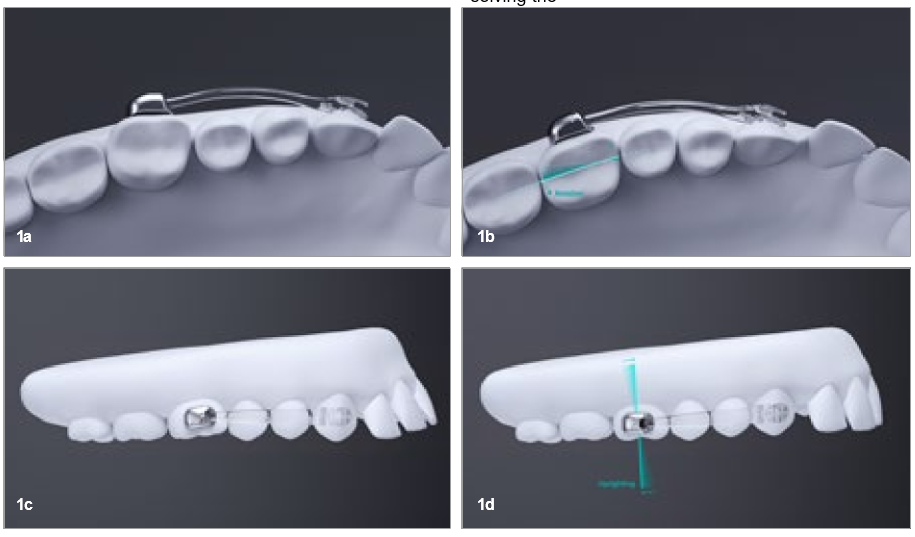
Figs. 1a–d: Accurate driving of uprighting and distal rotation with the new Carriere Motion Pro.
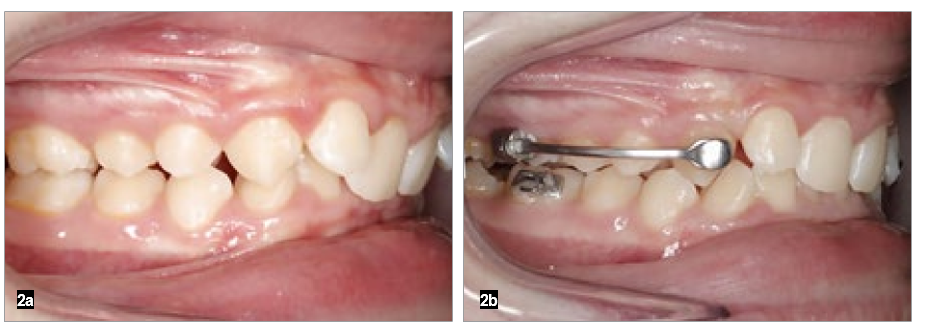
Figs. 2a & b: Case of a Class I occlusion accomplished in two months with the Carriere Motion Pro.
Today, patients request solutions for their malocclusion that are both aesthetic and efficient. The new Carriere Motion Pro is an appliance that uses design and biomimetics to substantially enhance the biomechanics of the original Carriere Motion Appliance, boosting the Sagittal First approach. Inspired by the shape and function of the temporomandibular joint, the new Carriere Motion Pro incorporates a totally new condyle shape hinge designed to produce ultra-low friction. This joint facilitates accurate distal rotation, precise uprighting and optimal molar torque simultaneously, achieving a Class I occlusion efficiently (Fig. 1). The knowledge of the last 20 years of using the original Carriere Motion Appliance has been employed in the redesign of the appliance to achieve next-level movement (Fig. 2).
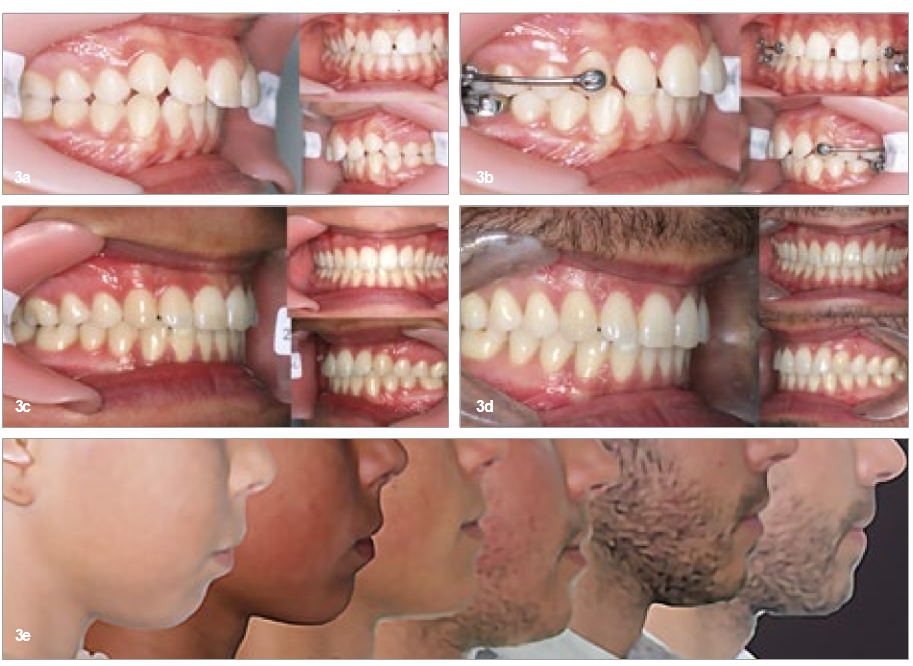
Figs. 3a–e: Case demonstrating the long-term stability of the Carriere Motion Appliance. Sixteen (16) years of follow-up of a Class II case.
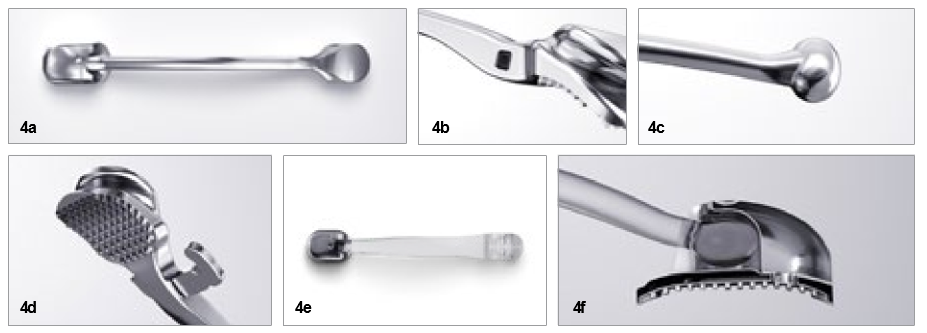
Figs. 4a–f: Various perspectives of the metal and clear Carriere Motion Pro.
The concept is to establish an accurate Class I occlusion with the ideal first molar position. Correct distal rotation and adequate molar uprighting promote a passive Class I occlusal scenario for the premolars and canines. If we do not accomplish adequate uprighting or distal rotation of the first molars, they will actively push the premolars and canines mesially, promoting the loss of the Class I occlusion during aligner treatment.
The key to long-term occlusal stability is the position of the maxillary first molars—83% of malocclusions have excessively mesially rotated molars and excessively mesially inclined molars.8 Mesial rotation and mesial inclination are scenarios that promote a premolar and canine shift to a Class II malocclusion. Rotating and uprighting the maxillary first molars is of paramount importance for generating long-term stability in both Class II and Class III cases.
The Carriere Motion Appliance and Carriere Motion Pro have been designed to drive those corrections and accomplish them with precision in order to establish a passive occlusal environment. In light of these necessary corrections, it is very important to understand that the Carriere Motion Appliance comes in a left side version and a right side version, and these can never be used on the opposite side. We cannot create a universal Carriere Motion Appliance for both sides if we want to accomplish a stable Class I occlusion, as the uprightness of the molars is essential (Fig. 3).
The Carriere Motion Pro, available in metal and clear versions (Fig. 4), features a stronger, reinforced and anatomically adapted hook. The hook is designed for easy attachment of elastics and offers biomechanically increased resistance to vertical pull stress. It effectively redistributes the elastic force, optimising the direction and distribution of the applied tension. Further new features include a vertical slot for drop-in hooks, which are particularly useful for treatment approaches that require minimal patient compliance.

Dr Luis Carrière, inventor of the Carriere Motion Appliances, obtained his dental degree from the Complutense University of Madrid in Spain in 1991. He then attended the University of
Barcelona in Spain and received his MSc in orthodontics in 1994 and his doctorate in orthodontics in 2006. He was
the recipient of the Joseph E. Johnson Clinical Award from the American Association of Orthodontists in 1995 and of a gold award for the Carriere Distalizer MB in the 2009 Delta Awards for Industrial Design, organised by the industrial design association of the Spanish association Fostering Arts and Design. Dr Carrière is on the review board of the American Journal of Orthodontics and Dentofacial Orthopedics and is a contributing editor of the Journal of Clinical Orthodontics. He lectures internationally and is a visiting professor at several university orthodontic departments throughout the world. He maintains a private practice in Barcelona.