Torqtech Red Band 1:5 Ultra Mini Handpiece
Part 02
Interview with the Developer of the Torqtech Red Band Handpiece
Morita released the Torqtech Red Band Ultra Mini Handpiece in October 2022 in response to requests from many dentists. This product was finally developed despite many difficulties through the high technological skills and persistent creative efforts of engineers at J. MORITA MFG. CORP. 12 years after the first release of the Torqtech series. We interviewed Mr. Hitoshi Tanaka, one of the engineers at J. MORITA MFG. CORP., for his insight into the development of the Torqtech Red Band Handpiece in Part 1 and the Torqtech Red Band Ultra Mini Handpiece in Part 2.
PART 2: Torqtech Red Band Ultra Mini Handpiece the Most Compact Size in the World
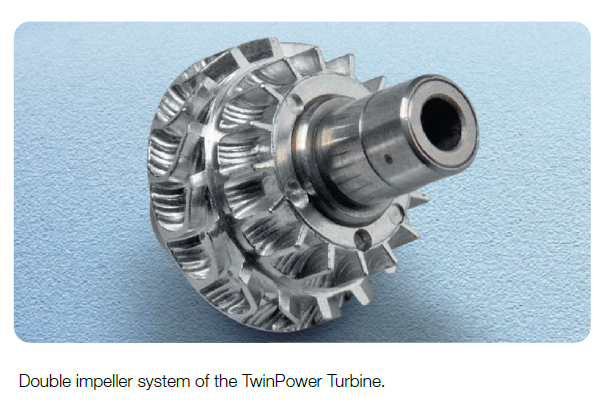
In 2022, the Ultra Mini joined the portfolio of the Torqtech Red Band Handpiece series. Tanaka: At the same time as the Torqtech series was released in 2010, Morita also released the TwinPower Turbine Ultra series (Powerful Micro Head). The power of a turbine decreases if its head size is reduced, due to the smaller impeller. Morita introduced a new double impeller mechanism, which achieved strong power and constant torque and was highly evaluated by dentists. We also received many requests for a smaller head size for the red band handpiece. However, to realize this, there were unique difficulties that were not present when downsizing the turbine head.
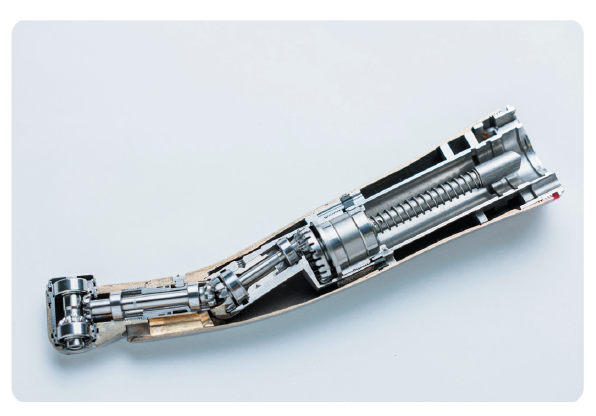
The downsizing of a turbine head is achieved by reducing the size of the impeller. In contrast, because a red band handpiece is driven by a motor, downsizing gears in the same manner would result in larger burdens on the gears and bearing, causing a problem with durability. Therefore, we needed to downsize the bearing without altering the gear system, while simultaneously increasing its durability.
There were unique difficulties that were not present when downsizing the turbine head. How did you improve the bearing?
Tanaka: A common bearing has an inner ring and an outer ring, respectively on the inside and outside of a ring-shaped groove where the balls rotate, with an inner retainer that retains the balls at equal intervals. The retainer is the most crucial element of a bearing and is also the most vulnerable to damage. Whereas metal materials are commonly used for retainers, a metal retainer rapidly wears out through fast rotation. Therefore, we use a special resin material for the Ultra Mini. Whereas resins are inferior to metals in strength, their extreme lightweight is stronger than metals against wear through fast rotation. Common resins easily deteriorate at high temperature and are therefore extremely vulnerable to sterilization, and can be damaged through repeated autoclaving. To solve this problem, we use a special resin material featuring both heat and steam resistance for the retainer part of the Ultra Mini.
Did you also improve the structure, in addition to the material?
Tanaka: There are two structures for bearings: deep groove bearings and angular bearings. A deep groove bearing has a ball placed on a deep groove, with the retainer holding the ball from one side and capping it with the outer ring. This is the structure used for conventional red band handpieces. The Ultra Mini uses an angular bearing, which withstands a larger axial load than a deep groove bearing. An angular bearing has a groove only on one side, with a basket-shaped retainer that holds the ball from all sides. By using an angular bearing, we achieved about twice the retainer strength and reduced axial run out. Through repeated experiments and durability tests, we achieved the present bearing specification over a period of about five years. The bearing is the core of turbines and contra-angles and is the most vulnerable to damage. Because technology continuously advances over time, our development has never ceased even after the release of the Ultra Mini in 2022.
The Ultra Mini also has an improved water injection method.
Tanaka: A conventional red band handpiece uses a threeport water irrigation system. In the case of three-port water injection, a complicated pipeline is required inside the head, which inevitably increases the head height. Therefore, we designed the Ultra Mini head to use a unique, single-port water injection system. However, with the single-port water injection used in general small heads, the water injection power is simply reduced to one-third.In the case of a red band handpiece, they are often used under higher loads than air turbines, and cooling the bur is important because heat generated in the cutting area may have an adverse effect on the tooth pulp. In order to avoid this issue, we developed an all-new wide, single-port water irrigation system.It has a water injection port in the center and two chip air holes on each side for a total of 4. This mechanism aims the water flow at the center and spreads it out in a fan shape. This makes it possible to cool a wider area from the shank of the bur to the tip.With single-port water injection, the water could easily miss the bur, which could cause the bur to heat up and the teeth to char. Wide, single-port water irrigation is unique and is unaffected by water and chip air pressure.(The wide oneport system is patent pending.)

What ideas were used in the wide single-port system?
Tanaka: Unlike common chip air tubing, which has one tube through to the air outlet, the Ultra Mini has a tube that branches to four air outlets. The holes are so small that it is difficult to visually find them on the actual product. Each hole is only 0.2mm, about the size of hair. Specialists with long experience in processing have combined their expertise to realize this product. Engineers engaged in production upgraded their skills through in-house training to handle the extremely precise processing and complex assembling necessary to produce the Ultra Mini. The final assembling and product inspection require especially high skills that only several engineers are certified for. Although this may not be an ideal process from the viewpoint of productivity, we cannot avoid this aspect in pursuit of the most compact size and the highest durability in the world.

We believe that, by going our own way to boldly challenge precise and complex processing and assembling, we can establish unique and unparalleled characteristics.
We cannot afford to compromise the knowledge, skills, and passion that we have inherited from our predecessors. We realized the Ultra Mini by aiming to develop the most compact head size in the world, resolving many difficulties one after another through concerted efforts of the development and manufacturing teams. I hope that clinicians will immediately feel the difference and experience the high usability and durability achieved through all these efforts.