
Dr. med. dent. Stefanie Feierabend
Prevention: yes. But how? One product for everyone? What happens if the patient doesn’t like the taste which means he finds prevention less pleasurable?
What happens if the form of administration is not suitable for the patient?
DMG now offers the product range Flairesse that is exceptionally broad and can therefore help to resolve the issues listed above. As well as those products that are currently the most commonly used such as polishing paste and fluoride varnish, the range also includes a prophylaxis gel (containing fluoride) and a prophylaxis foam. The polishing paste not only includes three different grits but is also available in two flavors, mint and melon. As an alternative to gel, DMG developed a foam, which is available in three flavors, mint, melon, and strawberry. The prophylaxis gel is also available in these three flavors. The fluoride varnish is available in the same flavors as the polishing paste, mint and melon.
This product line contains not just fluoride but also xylitol. Fluoride has been intensively researched for many years in terms of its mechanism of action in caries prevention, whereas xylitol acts in a different manner by reducing the number of microbes that cause caries in the mouth, that is, it has a cariostatic or anticariogenic action.
Prophylaxis paste
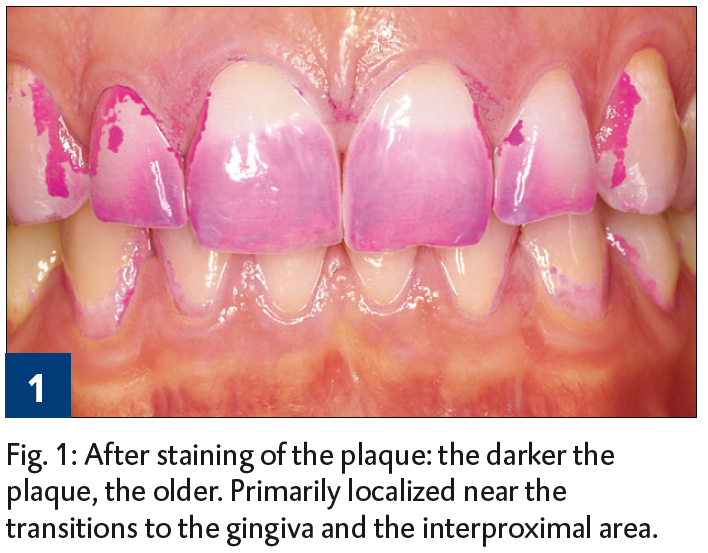
Generally, it is a good idea to stain the teeth of the patient before cleaning to be able to demonstrate to the patient where there is a need for improvement (Fig. 1). The color intensity after staining also enables the age of the plaque to be determined, thus providing indications about the oral hygiene habits of the patient. Depending on the intraoral situation or the quantity of plaque, it is a good idea to use all three grits/abrasion grades of the polishing paste. For significant quantities of plaque or if it is older, it definitely makes sense to start with the coarse grit. The patient can choose between mint and melon flavors. Often, but not always, younger patients in particular ask for melon flavor.
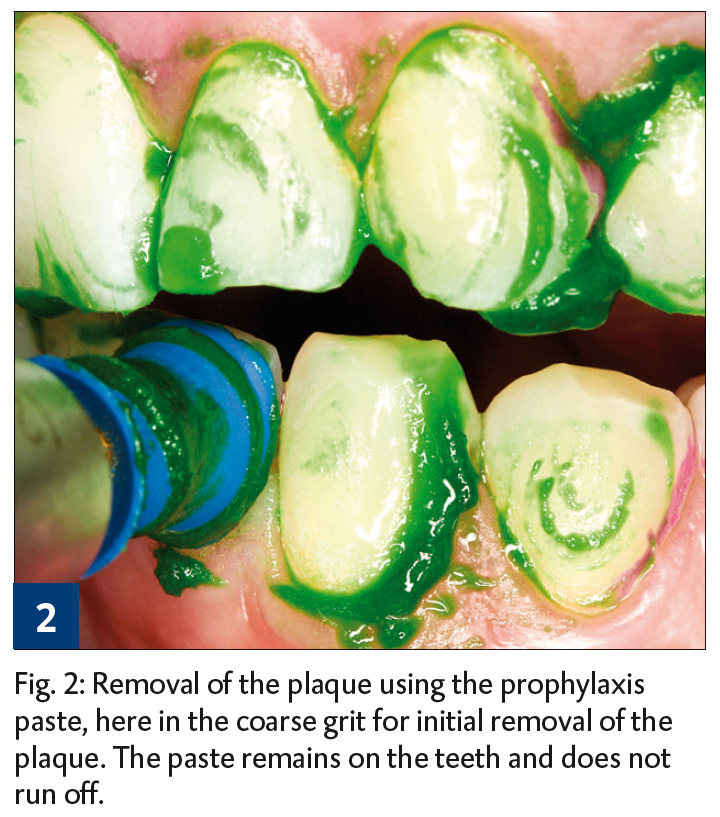
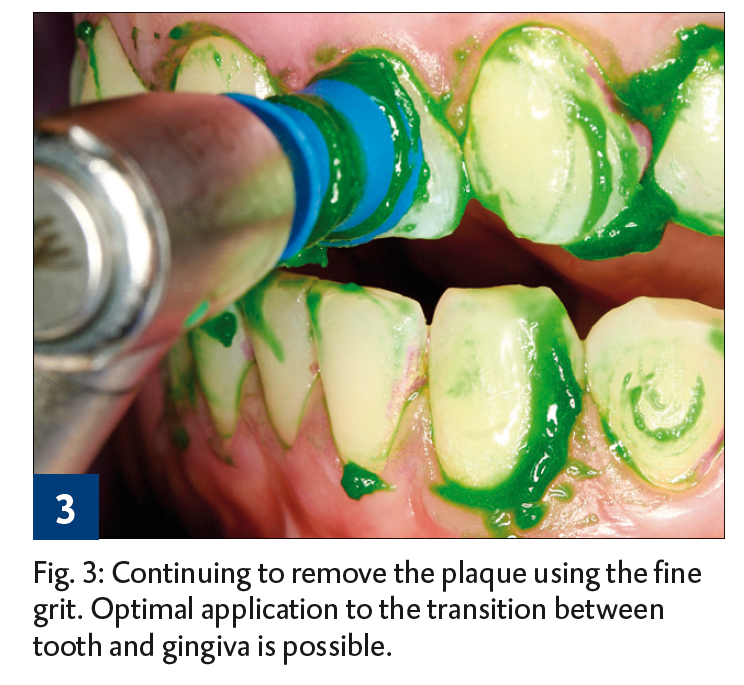
What is noteworthy about the polishing paste is that it does not work its way up the polishing cup and does not splatter but is instead pleasingly viscous, which enables thorough cleaning of the tooth surface (Fig. 2 and 3). These properties also mean that only a small amount of material is needed for cleaning.
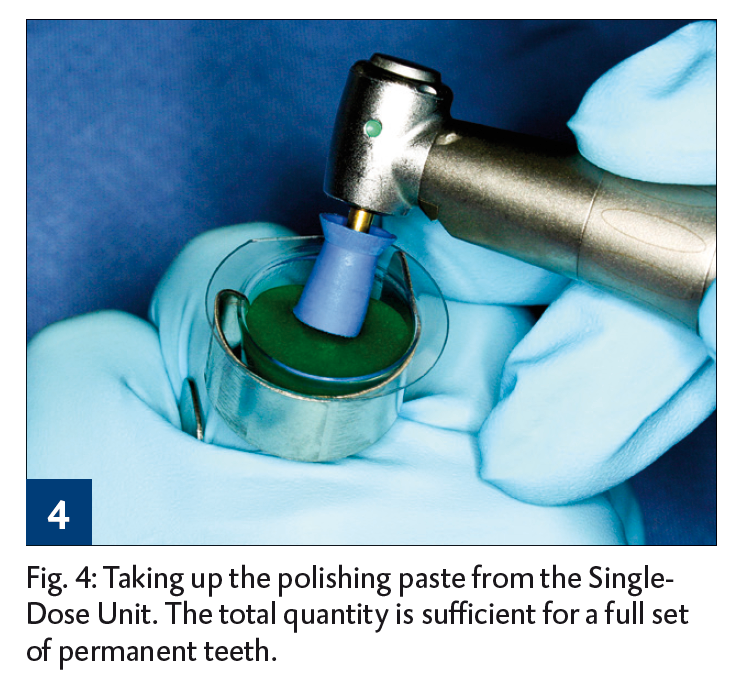
The preferences of the user determine whether the product is used either as a paste from a tube or as single doses held in place with a grip on the finger (Fig. 4). The Single-Dose Units are exactly the right size and one unit per grit/abrasion should also be enough to polish a full set of permanent teeth.
Prophylaxis foam and prophylaxis gel
Generally, the patients receive an intensive fluoridation after cleaning to encourage remineralization of the dental enamel or remineralization of any possible initial caries. The standard form of administration until now, a gel, is supplemented by another form of administration that is unique: a prophylaxis foam. Particularly for some patients, this is a real highlight of professional tooth cleaning thanks to its extremely soft consistency. Both versions, gel and foam, are applied in the mouth using a fluoride tray (Mirafluor-Tray, Hager & Werken) or using a polishing cup. Depending on the individual preferences, the patient and the dentist can not only choose between different flavors but also different forms of administration.What is very positive about the two products is that the consistency prevents the foam or the gel flowing into the mouth when using the fluoride tray (Fig. 5 and 6).
This is particularly important because not every patient tolerates intensive fluoridation using the polishing cup. To prevent leakage from the tray, the gel requires application of a smaller quantity material into the tray beforehand, which is not a problem at all thanks to the bottle with its small opening (Fig. 7). The broad product range means that it is definitely possible to closely involve patients in the choice of product.Another aspect that should be highlighted is the very short application time required (only one minute). Thanks to this detail and the consistency of the two products, it is highly likely that fluoridation can be done in a closed compartment because the product remains inside the ready-to-use tray. After withdrawing the tray, all that remains is to quickly remove any excess.
Prophylaxis varnish
The prophylaxis varnish, which is available in two flavors (mint and melon), has two areas of application: intensive fluoridation after professional tooth cleaning is complete and desensitization of hypersensitive tooth areas, particularly hypersensitive exposed cervical areas. The product is applied using a Single-Dose Unit with the integrated application brush (Fig. 8). Particularly for younger patients, this form of administration is very pleasant because it does
not induce any unpleasant associations but can instead be applied playfully. The quantity of varnish in the individual packages is sufficient for a full set of permanent teeth. Again, the patient can choose between refreshing mint flavor or the fruity melon flavor. The varnish is colorless in both flavors meaning that it cannot be seen in the mouth after application (Fig. 9).
Flairesse provides a complete system to carry out a complete professional tooth cleaning. The range of forms of administration and flavors means that both patient and treating dentist have a number of options which means that individual preferences can be met. The combination of fluoride and xylitol in a complete product range is currently unique. The consistency of the products makes them very pleasant for routine clinical use.
Contact address
Dr. med. dent. Stefanie Feierabend
Clinic for Conservative Dentistry and Periodontology
Hugstetter Strasse 55
79106 Freiburg
Email: stefanie.feierabend@uniklinik-freiburg.de
June 2014
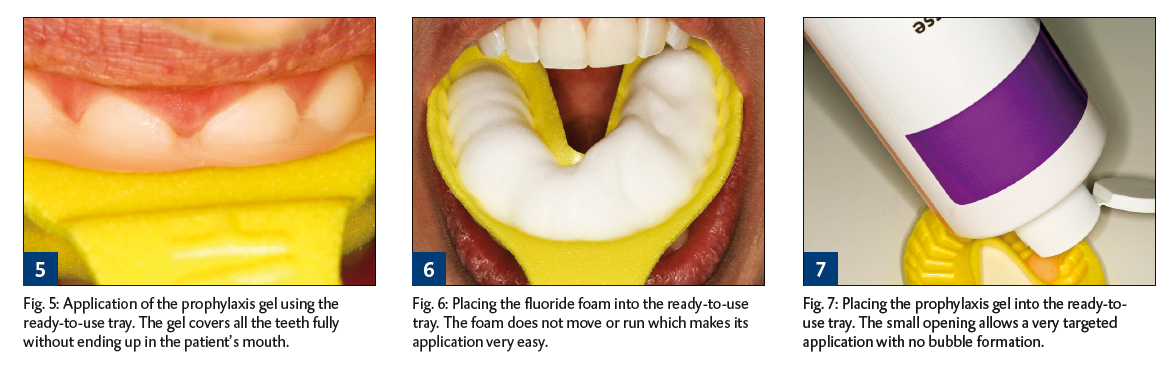
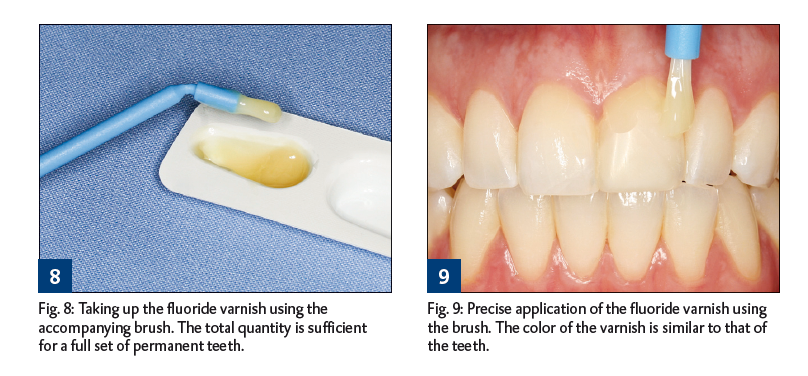
Fig. 1: After staining of the plaque: the darker the plaque, the older. Primarily localized near the transitions to the gingiva and the interproximal area.
Fig. 2: Removal of the plaque using the prophylaxis paste, here in the coarse grit for initial removal of the plaque. The paste remains on the teeth and does not run off.
Fig. 3: Continuing to remove the plaque using the fine grit. Optimal application to the transition between tooth and gingiva is possible.
Fig. 4: Taking up the polishing paste from the Single-Dose Unit. The total quantity is sufficient for a full set of permanent teeth.
Fig. 5: Application of the prophylaxis gel using the ready-to-use tray. The gel covers all the teeth fully without ending up in the patient’s mouth.
Fig. 6: Placing the fluoride foam into the ready-to-use tray. The foam does not move or run which makes its application very easy.
Fig. 7: Placing the prophylaxis gel into the ready-to-use tray. The small opening allows a very targeted application with no bubble formation.
Fig. 8: Taking up the fluoride varnish using the accompanying brush. The total quantity is sufficient for a full set of permanent teeth.
Fig. 9: Precise application of the fluoride varnish using the brush. The color of the varnish is similar to that of the teeth.